Thursday, January 22, 2015

Cyber safari news

 By Jules Knocker and Ali Kea

Smart phones have changed the way we view safaris. Some changes are good and some changes are not so welcome.
- Many people use the phone as their camera (by the way, not recommended - while phone cameras are good quality, they cannot replicate the majesty and the size of animals. Most end up looking small and a bit dull and not your best safari momento)
- you can share your day with friends and family back home, when you are at a lodge with Internet
- and we can hear about your safari from the guide as you go along and see the pictures, which we love

But it can become addictive, so much so that people forget to appreciate what they see first hand and concentrate on enjoying it second hand, via their phone - missing out on the full experience. So we really recommend that people 'switch off' during their game drives and at the lodge round the fire place, relax and enjoy!


19 Jan 06:12 - Alikea: Hi Sara !! Was good start yesterday, pick them up from Manyara we went in Manyara park and first thing was baboon, elephant very close to the road, giraffe , hippos , warthog and many water bird...
19 Jan 06:12 - Alikea: IMG-20150119-WA0004.jpg (file attached)
19 Jan 06:14 - Alikea: I mean very close to the road


19 Jan 17:30 - Alikea: Hi Sara! We had a nice morning, we left Sopa lodge at around 6:30 am with picnic b/fast and we went down in crater. We saw a pride of lions at Munge river. Was six of them next to a big group of Buffalo all looking to each other, big bull elephant, lots of nyumbu and zebra, gazelles, one rhino from distance. Then we had b/ fast at table mountain after that we found a pair of meting lion very close to road. A few meters away was another big male with a black main, close to them, around 2:30 client ask to come back to lodge for late lunch and rest..that is all about today...
19 Jan 17:31 - Alikea: IMG-20150119-WA0006.jpg (file attached)


19 Jan 19:48 - Sara May Ashby: Great stuff keep them coming

Safari myths and tall stories


By Kennedy John  


It is 1400 and too hot, so we decide to drive to our Lodge. We are staying at Lake Manyara Tree Lodge. On the way, we make jokes about the famous tree-climbing lions of Lake Manyara National Park, which, in my experience, you rarely see, despite the fact I have visited the park many, many times.
Some guides and guide books claim you can only see lions up trees in Lake Manyara and nowhere else. Of course, this is not true. Lions, like all cats, can climb trees and the younger ones often do.

Imagine my surprise when we round a corner and about a kilometer before the lodges, we saw five of them: 3 females and 2 young males, sitting in the branches of a kigelia (sausage) tree

Big is beautiful

Trips with a big group can be daunting - and not just from the organisation point of view and the logistics of moving so many people around but also making sure everyone gets the best possible experience and no-one is left out. 
We recently ran a trip for 42 people in the Serengeti and Zanzibar. The trip was a great success for all - not just the safari visitors but for our guides as well. It is not often that they get to do trips together and have fun, relaxing with their friends. As well as the jokes, there was plenty of time to learn from others, to help each other out. Here goes with a few comments from our guides.....


And if you think the thrill of having a fully grown lion near you dims with repetition - it does not. Look at Rem's face!


- our mission was hippopotamus today, at Retima. It was fabulous, crocodiles as usual and hippos piled up. Don't forget soooooo many different types of birds. and the evening was something unique. Mating lions before sundowners and accompanied by traditional maasai dancing. To be honest, from my side, the safari was excellent. (Rem)


- the first late afternoon drive was adrenalin laced, when we spotted a lone cheetah stalking some gazelles. The deed was done in the thickets! And an imposing memory of the African elephant sauntering across the plains in the midst of the wildebeest and zebra migration was a highlight of my safari. (Masaa)


- it was a great safari with knowledgeable guides. Full of a variety of animals, birds and trees.  It was terrific (Ali Kea)


First impressions are always important. Here goes with an impressive fan of our vehicles, all spic and span, ready for anything.
Safari duties are not always about spotting game and driving across the bush. Here, our intrepid guide team rigged up some parafin lights to help the celebrations along


Is a safari ever long enough?


By Chediel Mnzava  


Our safari started at the Namanga, the border post between Tanzania and Kenya and we drove all the way to the Ngorongoro Highlands via Arusha, Mt Meru and Mt Kilimanjaro. Kilimanjaro is the largest free standing mountain in the world. and before it erupted many centuries ago, Mt Meru was even higher. The mountains were in our view but not for long, as they soon got covered in cloud. Best viewing times for the mountains are early morning and late afternoon.


Our first game drive was in Ngorongoro Crater and we had a very early morning start. It was worth waking up early today, as we saw a lot in the Crater, without most of the crowds. Ngorongoro has become very popular over the last decade. We saw wildebeest and zebras, elephants, lots of gazelles then we met up with some some lions and one lioness had three cubs. Cheetah and of flamingos on the lake. You could not beat that as a first day to introduce people to the joys of the wild. It was a good day.


Our next destination was Moru in the Serengeti National Park as that is where our mobile camp was. The great thing about transfer days is they often are glorified game drives and you see plenty along the way.
As we went across to Naabi hill, we started seeing some small herds of wildebeest. As we were got close to Moru, we noticed the Migration was getting thicker and thicker. By the time we got to Moru it was full of wildebeests and zebra. The sheer number of animals was astounding.


Yet along with the wildebeest, we saw plenty of other game from big cats down to small beetles; from colourful birds to colourful flowers. Each day brought something new or a different way of looking at animals. Eight days just was not enough

Predators and Prey in the Serengeti - March April


Predators and Prey in Serengeti by Halifa Suleiman


Good news......... in the Southern  Serengeti, the hunting dogs are around ! An early morning start will give you a good chance of enjoy the  dogs hunting.  The cheetah cubs plays under the shade of the acacia tree.


 The wildebeest are lactating, while the hyena rests in their den.  At the same time, some warthog wanted to get down the same den ( burrow) and the hyena were pushed out ! An elephant  family walks towards a water hole. It's hot for calf but they have to keep walking.

The Highlights of the Green


The Highlights of the Green - by Kennedy John
March 2013


Sexual shenanigans in Mahale! The present Alpha male chimp (Primus) behaves very badly by trying to rape his sister! This same behaviour led to Pimu, the previous Alpha, getting deposed and killed just last year. He needs to watch out as the Chimp group will not put up with that kind of bullying.


Ndutu southern short grass plains. Day 1 was shocking - no wildebeest. Then it rained and the masses started pouring into the area we were in and hence, the fun started. The climax? A mother cheetah with her 4 cubs killing a tommy and then the beests started dropping calves left right and centre (that's Ndutu at its best!).


Ngorongoro Crater,being there at first light was rewarding. The sight of a huge black-maned lion surrounded by a pack of hyenas enjoying his breakfast of the wildebeest he had just caught, with the most fantastic sunrise over the crater highlands..


Friday, September 26, 2014

Bikes, bush and beauty - a safari with a difference

By Richard Knocker I'm half way up the 2nd hill - we've only just started, and it's clear that I just can't do it. This is ridiculous! Somehow I puff and pant my way to the top, and a lovely view opens up below: in the distance, the steep escarpment of the western wall of the Great Rift Valley; ahead the track swoops down to a broad plain, a patchwork quilt of maize and sugar cane fields; to the right glints Lake Babati, our destination for today, some 50 kms (30 miles) away. This is Part 2 of the Vijana Challenge (vijana = boys in kiSwahili) , a 3-week voyage of learning and adventure for my 4 young charges from Switzerland and Canada. We have already completed a short bush mechanics course and an introduction to wilderness 1st Aid; yesterday evening, we hiked up to view the ancient rock art of Kolo in the caves and rocky overhangs that dot that part of the Rift. We are just starting a 120-kms bike ride and the we are getting into our stride. Our guide for this section is Julius, a lean young man with dreads and a great sense of fun. For back up, we have Juma, a biking legend: he can fix anything on 2 wheels, under any circumstances. Free wheeling downhill with the wind in my face, my early sense of despondency quickly wears off and I soon start to enjoy the ride. This is easy! From now one. it's all fun: we pass through rural villages, where people smile and wave at the wazungu (white folk) on their bikes; through patches of airy forest, and through acres and acres of sugar cane. At the end of the day, I spot my chance: on the slope leading up to camp, I stand up on the pedals and push hard, blasting past Julius and the 4 teenagers, who, not suspecting that the old fuddy duddy bringing up the rear has it in him, are completely taken by surprise. Camp is a lovely spot in a grove of tall fever trees right on the lakeshore; fishermen come and go and some cows graze peacefully nearby, We go on a short bird walk, which yields fruit galore: highlights were a Purple Swamp-hen, a couple of hippo, a dik-dik and a Scarlet-chested Sunbird feeding above us. And lots of waterbirds... Next day we are, unsurprisingly, saddle-sore as we mount our trusty steeds once more. We have a little over 60 kms ahead of us, but I have no doubt that I can manage. Sure enough, we arrive in time for a late lunch at Magara Campsite, a pretty location on the edge of a sand river set about with big sycamore figs. A short distance away are the Magara Falls, where we go for a wallow in the chilly water and to be pummelled by the full force of the main waterfall. Hugely reinvigorating! Afterwards, a young local boy, Musa, demonstrates his gymnastic abilities, with a series of somersaults and back flips in the sand. Next morning, it's an early start: we're off to nearby Lake Manyara National Park. We have the option of a full day in the park, or a half day followed by another bike ride. The lads are unanimous: time for some seeeeeerious game viewing! Almost immediately we are in the middle of a group of elephant, feeding peacefully in the forest in the new southern extension to the park. Soon after, we emerge onto the lakeshore, where herds of wildebeest and zebra wander, with warthog and impala dotted around. As we approach the Maji Moto hippo pool, we come across throngs of water birds: storks, herons, ibis - and thousands upon thousands of pelicans. They are everywhere, swimming in vast flotillas, sailing majestically overhead, squabbling in the trees. Can there really be enough fish in the rapidly dwindling lake to support this many birds? The answer is clearly yes, but surely not for long? Next morning, it's time to move on. We say goodbye to Julius and the crew and head off with our new best friend & guide, Kilerai; we will spend the next few days with the Hadzabe, some of Tanzania's last hunter-gatherers, who somehow make a living from the harsh, jutting landscape of rock and thornbush around Mongo wa Mono and Yaeda Chini. It's an austere place, especially in the dry season, as now: the colour seems to have bled out of the world, leaving a palette of ochre, olive and grey. It is strangely beautiful. The next couple of days pass in a blur of wonderful times spent with the Hadza; a morning spent with the women as they dug up edible yam-like tubers; finding honey in a beehive high in a baobab tree; making arrows, Hadza-style; hiking across the Yaeda Valley; and heading out at dawn each morning on hunting expeditions, each boy accompanying a Hadza hunter. Each day is packed with fascinating incidents on their treks through the bush, covering many miles on each outing. One day, Jenerali notices that a nearby marula tree is fruiting and that many animals - kudu, bushpig, duiker - are visiting each night to hoover up the fallen fruit. After a brief discussion, we all set out to build a blind 20m from the tree and the boys wait up to try their luck. It is a beautiful full moon night. Towards morning, the clatter of a displaced pebble alerts them - there in the silvery light stands a herd of Greater Kudu; they are wary, their delicate ears twitching back and forth, searching for threats. They sense that something is wrong and they melt into the night once more. All too soon, this part of the adventure draws to a close, and we have to say goodbye to our Hadza friends. The final leg takes us to Tarangire for more big game; this park is excellent in the dry season, with large numbers of game dependent on the permanent water sources - the Tarangire River, Silale Swamp - now that the rest of the ecosystem has dried up. Elephant and large buffalo herds are everywhere and each night we are treated to a lion chorus as the different groups roar to each other. Damien is on a wild dog mission - there have been some reports of late, so we check out all the best places, but no joy. No luck either with oryx, but we score with lesser kudu, terrific cheetah and leopard sightings as well as some memorable views of lion.

Monday, October 14, 2013

Snippets of safari memories

By Halifa Suleiman

Northern Serengeti at the right time and in the right place.
The Mara River offers up what many hope to see: the crossing of the wildebeest and the monster crocodiles that wait from season to season to feed well. The croc was not so lucky this time - the wildebeest got away
The woodland hiding many creatures and a rhino......just chilling.


The kopjes all seem to glisten with cats this time, the trees hung with vultures and eagles waiting for their turn at the trough.. A Martial Eagle plucking an Egyptian Goose.

And the view, shaped by passing herds of elephant. A tree down here, a bush pulled up there.


The end of the dry - November in Serengeti


By Chediel Mnzava

The end of the dry season - it does not happen on a particular date or day or week. Each year is different and we usually chose two locations with flexibility or two different locations to give oursleves the best chance at meeting up with the herds.

The safari starts with a change of camp. The change in the weather means that the migrating animals are not where we had anticipated them to be at this time. So the first conversation I had with the clients was all about why we were going somewhere different.
On the vast short grass plains, as far as your eyes can see. Kopjes in the distance, big sky. That is how our safari started.

We were interested in everything: animals, birds, plants but our first big cat sighting was a leopard with a kill on top of a kopje. For me, it was particularly special as we were the only people there.

Ewanjan Camp in central Serengeti was our starting off point and we saw all the big cats, small to big antelopes, elephant and zebra.....and it rained while we were there so we saw a lot of wildebeest flowing into the area. Our three nights at the Makoma Hills were excellent.


The drive from Makoma hills to Lamai Camp was interesting, through the moving herds of gnu. Half an hour after we left camp, we spotted a Giant Eagle Owl then from nowhere, a leopard showed up and walked very closeto our vehicle. She came to drink water from one of the puddles just in front of us and then disappeared into thick vegetation. We all congratulated ourselves on our luck not knowing that she had not gone far. I heard a funny sounds from the kopjes and when I looked, I saw her two cubs.

The nice part of this safari was seeing the Serengeti landscape change from one area to another. The park is not huge in terms of kilometers but the variety of habitat is impressive.

Thursday, September 19, 2013

August - Ngorongoro and the Migration in Serengeti

Lake Magadi, Ngorongoro
Ngorongoro Crater, a cold, cloudy morning. A lioness lies by the road, hidden from a nearby wildebeest herd by the slope of a drainage ditch. She focuses on 3 animals that are drifting closer to her as they feed. Their path changes subtly; decision time. If she waits, they may walk out of range, but if she charges, she risks missing them as they are still a good distance away. In the end, hunger drives her to make the attempt, and the startled gnus run panic-stricken from her. Her presence is now known to all, so she decides to move on, try pastures new. She walks surprisingly fast. It is warm, approaching mid-day, an indication of how hungry she is. She spots a lone zebra out in the plain. Lone animals are easier to approach than herds, which have the benefit of lots of eyes all looking out for threats; alone, the zebra must rely on its own senses to survive. She starts her stalk along a small gulley. The zebra, unaware of the danger, moves onto more open ground. Suddenly he spots her approach and stares at her, snorting. She realises the game is up and moves off once more. From a small rise, she spots a line of wildebeest on the move. She moves fast to intercept them, getting into position in a grassy thicket close to their line of march. The herd keeps coming – it seems that they must tread on her. Suddenly, a tawny blur, wildebeest scattering in all directions. When the dust settles, she is left standing there. She has missed again. Frustrated, she lies down in the grass and begins to groom. It’s not as easy as it looks being King (Queen?) of the Jungle.

Hunting lioness
Kogakuria Kopje, north Serengeti. A dead spider lying on the path. Suddenly a shiny blue-black wasp emerges from a small hole, looks at the spider then continues excavating once more, showering earth particles backwards like a dog digging. After a few minutes, the wasp returns and drags the spider into the hole, which looks far too small. Somehow the wasp manages. The spider isn’t dead at all: the wasp has paralysed it’s prey with a careful sting; it will now lay a single egg on the spider – and the grub will be provisioned with plenty of fresh food when it hatches, a neat solution to the problem of food storage. Not a great outcome for the spider though…

Midday, north Serengeti. It’s hot. In a thick tangle of branches atop a nearby rock, we can just make out a patch of patterned fur. A resting leopard. We wait. There is a rustle in the bush and a lithe shape emerges onto the rock nearby, followed by second animal. With a mix of flirtatiousness and much snarling and apparent ill will, they mate in the typically perfunctory manner of large cats. Within minutes, they mate again – and then again. But the level of hostility doesn’t abate one jot.
(Watch the video: http://www.youtube.com/watch?v=Qa9Kk2nZmeo)

Crossing season is in full swing, with herds lining up on the river bank, jostling and shoving, pouring down the bank and into the water.  A chaotic scene of dust and pounding hooves, the animals hurling themselves into the river, eyes wide with fear during the swim, then emerging dripping at the far side before running off once more over the plain.  Some youngsters decide to cross back again - a croc slides into the water, easily overtakes a straggler... there is a lunge, a brief swirl, and the brown water closes over the swimmer's head.
Mara River - crossing

Crossing the river
(Crossing video: http://www.youtube.com/watch?v=3p12X9nmdBI)

Kogakuria, early morning. We heard lions roaring as we set off, so we are trying to track them down. We try one set of rocks, where we estimate the sound came from but no joy. Then Jairo spots them, distant specks in the huge Serengeti landscape. They appear to be on the move - hunting? But all have full bellies. There is a fresh kill nearby and one small lioness has blood on her neck. One by one, the ladies move off, until we are left with two adult males and the small lioness. Suddenly, mayhem – the males attack the female, who defends herself ferociously, lashing out at them. They circle her, looking for an opening, as she crouches, ears laid back against her skull, snarling and spitting. They move in again and she launches herself at them, a blur of whirling claws and teeth. The males roar at the morning sky, then move off, leaving her to lick her wounds.
(Lion fight video: http://www.youtube.com/watch?v=MJ4dak3Qoxw)

Martial Eagle on Egyptian Goose kill

Lamai Wedge, North Serengeti

Wednesday, June 27, 2012

Rewarding June


By Richard Knocker


My season kicked off the other day with a 4-day trip to Lake Manyara and Ngorongoro.  


Lake Manyara is looking great this early in the season, with plenty of water still, and lots of Lesser Flamingos too.  Much of the lake is fringed with pink and flocks can be seen flying from point to point a lot of the time.

A herd of 19 giraffe comes thundering out onto the lakeshore, then turns to stare back into the woodland.  We scan and scan for lion, but the bush is just too dense.

As we enter camp, we are surrounded by a herd of peacefully munching elephant, shattered trees lying all around.

During the night, the peace is broken by a troop of baboon, barking out in alarm as a leopard does the rounds.


We leave at first light for a leisurely morning in the southern part of the park. Breakfast is on the lakeshore with a dense wodge of flamingos barely 30m away.  More keep flying in and, as we eat, there is a constant babble of goose-like honking.

Probably the highlight of our Manyara stay is a large tom leopard strolling along the road ahead of us.  He disappears into the trees as we approach and we catch a glimpse of spotted coat in the bushes, before he melts into a thicket.  We sit quietly for 20 minutes or so, hoping he will re-emerge or climb a tree, but no joy.  Another group saw him later, and a female crossed the road nearby – most likely a mating pair.

***

 A wonderful sight on the descent into the crater: a caracal, the most beautiful of all the African cats. She is carrying a mouse, and as we watch, a well-grown kitten comes out of hiding and proceeds to eat.  They aren’t at all shy and we have a wonderful few minutes with them.


Up before 1st light so as to make the most of the early morning in the Crater.  There is a thick fog and as we make our way around the rim, we almost run into a buffalo on the road.  In the weird light, its dark body is almost invisible and we all but nudge its bottom before stopping.

On the descent, there is the caracal pair again.  The kitten is once more feeding on a mouse, presumably caught by the mother.  The light is very uncertain, but we get close-up views of the wonderful facial markings and long tufted ears that give this cat such an exotic look.  Gorgeous…


On the Crater floor, a large bull elephant comes walking along the road towards us; we pull up and wait for him – he walks right by, pausing to glare and flare his ears at us, just in case we haven’t grasped quite how massive he is.

Not long after, a pair of hunting lions.  They are in a good position, with plenty of game nearby.  A wildebeest walks right towards them, oblivious.  A short rush… and the lion stops dead.  It turns out that he is a youngster, still short of his 2nd birthday, and probably lacks the confidence to take on a fully-grown bull wildebeest like that, with scary looking horns!


And to round it off – a magnificent Martial Eagle atop an acacia, plucking and eating what looks like an Egyptian Goose.  What a fabulous bird….

Sunday, June 10, 2012

Leopard, and more leopard, December 2011


       By Squack Evans


During the course of 12 days or so, we travelled through Manyara having some phenomenal elephant viewing at close quarters..... some of the best I have had in Manyara for some time.


Following on from there, we went to Ngorongoro and on to Moru kopjies.


We had a lot of rain so were a little bit constrained due to mud, in some areas. However, we had phenomenal sightings. The leopard viewing started here and we saw, in one morning, 3 leopards. One at a distance had just killed and climbed a tree with a dikdik. We managed to find one of the resident lion prides as well as a Black Rhino.


We moved on to the northern Serengeti and the leopard sightings continued in earnest! A mother and adolescent cub with an oribi kill giving us some amazing shows. The cub had attitude; with a snarl and a hiss almost on the end of my camera lens and then it hopped up on to the bull bar of the car.


The next day we found the mother again hunting and climbing trees in the heat of the afternoon. In the evening, she had moved some distance again and gave a phenomenal modelling shoot!


Lions were plentiful as was other game and, being slightly out of season, there were very few other cars out and about.


Our send off at the end was 4 Black Rhino and some interesting interaction as it appeared that a female in the group was in season. Great trip..... and the leopard stole the show.

Monday, June 4, 2012

Misty mornings, Ndutu, November 2011

By Squack Evans

A wonderful week-long safari with the Wilderness Mobile Camp in Ngorongoro and the southern Serengeti with guests who have become firm friends over the years.


The first few nights we spent on the Crater rim, the campsite is already some way down the descent road so you are set to be first in to the Crater, with a good head start. We had some quality game viewing in the golden morning hours, while the late afternoon on the Crater floor is equally magic; everyone had headed home and we enjoyed the last light in glorious isolation.  


 As we arrived in Ndutu so too did the wildebeest, a few weeks earlier than we expected! The beauty of having a lighter-weight mobile camp and  travelling out of season means you can change plans on the move. As the wildebeest had arrived so early, we decided to stay put for the rest of the week. What a great time! The morning mist was so thick we couldn't see further than 40 yards ahead and what a  rare treat to be drifting slowly through the mist and watching shapes slowly appear and begin to take form as you approach, and then drift back into nothingness as you pass. 


Being on the plains as the mist finally burnt off was great. Suddenly, huge vistas of grassland and wildebeest opened up to accompany our picnic breakfast and tea.


We also spent a lot of evening time with a Striped Hyena and her pup. So rare to get good views of them and even more rare to watch behaviour between mother and pup.  


We had a cheetah mother and her cubs having a standoff with a few opportunistic Spotted Hyena, a lioness taking advantage of the sudden abundance of food among many other fantastic memories. 
The short grass plains in southern Serengeti in early season were both tranquil and beautiful! Next November anyone?

Thursday, April 26, 2012

Drama in the African Bush


By Halifa Suleiman


Clouds ! Mist ! Fog !


Halifa ! ARE WE GOING TO SEE ANY ANIMALS TODAY? this is the question from my guests. The Ngorongoro half day trip was the start of our safari and the fog was heavy. But down on the Crater floor it cleared up. At the first sighting, we saw four lioness hunting a buffalo. These girls took about 45min to bring down the buffalo bull, after breaking its front left leg, but it was not easy.

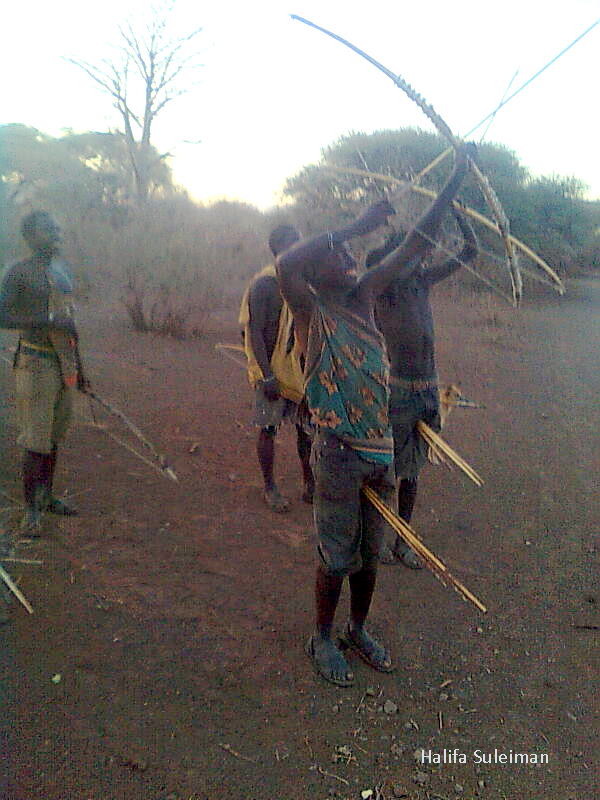
A good morning hunting with the Hadze at Lake Eyasi.  Breakfast is a male vervet monkey before they set off again hunting. The luck of the day was on their side. After a long walk, stopping to pick some cordia fruit and catch some mouse bird, they shot the egyptian goose with their bow and arrows .


It is hot and dusty in Tarangire but another wonderful day with elephant heading towards the river, zebra under the tree and wildebeest near the river bank. On the other side, a lion hiding in wait. In the three days of our stay, we saw orxy, kudu, eland, python, leopard , lion and many more. A martial eagle caught a dwarf mangoose and took it up to a tree branch, what a meal !